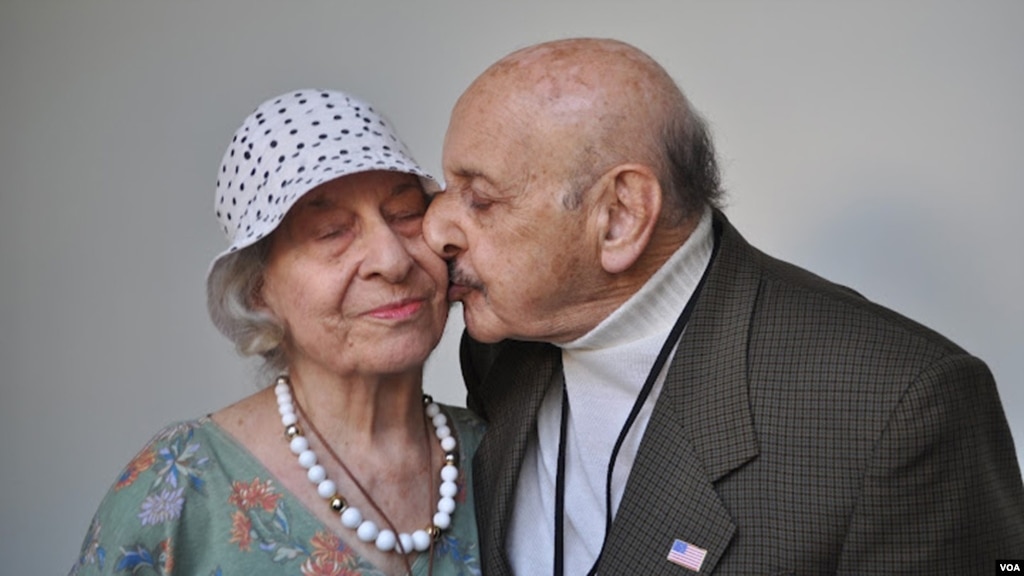
John Lennon's retirement celebration was last Friday.Below watch the amazing video that Amish put together, see photos from the party, and read John's farewell speech.If you have memories of John that you would like to share, please post them in the comments!
Text of John Lennon's farewell speech:
Text of John Lennon's farewell speech:
I came to work at VOA at time when things were simpler in some ways, and our job was more easily defined. In those days Congress funded VOA as an adjunct to USIA’s efforts to tell America’s story to the world, to help win hearts and minds, to combat Soviet disinformation in the raging Cold War. We sent radio programs on shortwave across distant borders to people we couldn’t see. We didn’t know who they were, and we didn’t know how many we reached. For the most part, those concerns were secondary. It would be a generation before we would talk about markets, and brands, and demographics. The competition in those days was for hearts and minds, and the only competitor was the monolith to the east.
In the late 1960s Lyndon Johnson was serving out the end of his presidency, having been driven from office by a war in Southeast Asia that was far from over. China had just begun its disastrous Cultural Revolution, and commentators figured it wouldn’t be a player on any world stage for at least a century, if then. Europe was sharply divided, military dictators ruled most of Latin America, and it would be another decade before the US would begin to recognize the potential of post-colonial Africa. Closer to home we were comforted by predictions that Fidel Castro would be overthrown in a Cuban uprising just any day.
Because we thought it was good for the world and good for us, America offered food aid, schools and hospitals, Peace Corps volunteers by the thousands, and scholarships for young people who wanted to come to the US to learn because they had no way to earn a degree in science or engineering or medicine or law at home. We offered that chance, and people took it… in those times and for years to come, we offered hope – and people needed it.
The world hadn’t yet heard of HIV-AIDS, or global warming, or OPEC, or crack cocaine. Among broadcasters, FM was a seldom-used diversion, TV was a black-and-white curiosity, “digital” was a word used in the study of anatomy, and “Internet” described a complex method used by fishermen for sweeping up bottom-feeders. Among journalists, newspapers and wire services were king. The foreign correspondent was a god, a remote but omniscient deity at the end of a fuzzy phone line whose word was never questioned, whose reports were eagerly sought, and who, in some cases, enjoyed being out of sight by staying drunk for years on end. Competition for such positions was all the more ferocious.
On the whole, journalists fiercely debated the importance of objectivity, the value of green-eye-shade editing, the imperatives of careful sourcing and deadlines and good writing. Universities offered new degree programs in journalism and communications. If public service was a public trust, the Fourth Estate declared itself an even higher calling, a watchdog, the last line of defense against corruption – the best example of high virtue in a Jeffersonian democracy, touted by people who hadn’t yet heard of Sally Hemmings.
In that tense time, as post-war journalism matured, and as Cold War diplomacy dominated the headlines, the Voice of America was moving into a new era. Its coverage of wars in the Middle East and Southeast Asia, of the turbulence of American social and political change – and, later, of the constitutional crisis called Watergate – all these efforts brought new respect for VOA reporters in the field, and for our broadcasts around the world. And with this respect, it came to us – a dawning awareness of new responsibilities for accuracy, for balance, for comprehensiveness in covering American life and US policies… values that would find their way into a VOA Charter that was already in draft, and would later be passed into law.
Then as now, “integrity” was a word much in use… and people who moved between journalism and government were viewed as having been compromised in their integrity, more interested in personal advantage and reputation than in the values of one calling or the other. Then, as now, a small chorus maintained that neither the career politician nor the ink-stained wretch were particularly honorable in their pursuits, and called for a pox on both houses.
As to whether VOA could maintain a reputation for integrity in those years, a famous and respected broadcast journalist – John Chancellor – summed up a view toward the end of his brief tenure as Director, a view that stuck with us for decades – that VOA was at a crossroads, at an intersection between journalism and diplomacy, with responsibility for deciding on any given day, or story, which way to go. Damned if we went this way, damned if we went that way.
It was a heady problem in those days, those days of a bipolar world dominated by Cold War tensions and daytime dreams of a nuclear nightmare… but today, the dilemma of 50 years ago seems quaint, as gripping as it was then. By contrast, today’s problems are technically more complex, politically more urgent, more personal, more compelling, more desperately in need of solutions.
If VOA was at a four-lane crossroads with one swinging stoplight in the 1960s, today it is in danger of getting lost in the speeding swirl of honking traffic on the world’s over-lapping information clover-leafs and multi-lane Autobahns. We don’t just face the consequences of making a wrong turn… we are faced with the certainty of becoming road kill, pancaked by behemoths, torn apart by “transformers” – unless we are both nimble and strong; intelligent and responsive; skilled and intuitive; quick-witted and thoughtful; well motivated and well led; proud – and also humble. With respect to Mr. Chancellor, today’s a hell of a time to be in our business.
There is a way out of our current dilemma. But all of us – all of you – have to take ownership. VOA need not be as rich as Chinese TV, or as ubiquitous as Russia Today, or as aggressive as Iranian media, or as pointed as Aljazeera. Instead we can agree – and I think we can all agree – that we have the methods and the motivation to become the most respected and sought-after source of news and information in the world. That’s a tall order – but why not? If that is VOA’s vision of itself, what is to keep us from setting the goals that will get us there? And what needs to be done to remove the barriers in our way? There are things that we can do – and I’d like to leave you with some thoughts about three of them.
First, VOA journalists in every language must focus on original reporting on all media and, in the context of that reporting, they must identify clearly with the concerns and the issues and the problems facing their audiences. Lingering Cold War methods must be discarded. People in search of news no longer have to wait for us to translate vetted English-language copy drawn from secondary sources… they have only passing interest in our version of events they heard about yesterday… and most telling of all, the growing billions of young people glued to their cell phones around the world want to know what’s of interest to them now; the rest they regard as mostly irrelevant. We have to know what interests and excites that audience, those young people, those consumers of our broadcasts, and take every bit of our mission to them on today’s platforms in original stories that are written and produced in a way that compels them to stick with VOA – because we care about them, and about their issues, and who they are.
The second is related to the first. Compelling original reporting that will draw audiences to VOA’s mission can only be truly successful if we learn as much as we can about today’s audiences, the people who consume today’s media, in today’s markets. Audience research and information may come from Gallup, or InterMedia, or personal travel or interviews, or a careful review of the Internet… but it is essential to the daily preparation of material by journalists focused on pulling in an audience. If you don’t know who they are, you can’t talk to them, or about them – or about anything that will interest them. This essential component is sometimes overlooked in favor of predispositions or conventional wisdom or old habits; VOA journalists in all languages must be professional enough to admit the possibility that they need greater knowledge and understanding when it comes to the people who matter most – the members of our audiences. In the same way, we need to know as much as we can about the markets in which we’re operating – whether we’re on TV and FM, or shortwave, or the Internet; how much of what kind of media do audiences use, to get what kind of information, under what conditions? These are important questions that need answers before you can prepare that compelling original story. Performance Review and OMPP have substantial resources to help in this regard, and all of you have resources of your own. They must all be put to use.
The last step that we need to take is one that can’t be taken by VOA alone. It’s a step that requires leadership, and wisdom, and a true embrace of a vision for all of US international broadcasting. The step is one that brings all of our competing entities into the same tent, a big tent that accommodates many brands, but that also requires collaborative efforts at building audiences around the world and especially in places where the need is greatest. Our original multi-media products must be tailored to meet the needs of specific audiences and markets, and adapted to inform audiences elsewhere. All brands and media platforms must be accommodated by unified systems for production and distribution. This streamlined agency must be led and managed by a Chief Executive Officer hired by an Advisory Board. For all of this we need strong and visionary leadership at the top of our Agency. VOA can’t take this step alone.
This last step must be taken because the world is not as simple as it was 40 and 50 years ago, not in any way. Today we must be competitive at many more levels and in many more ways than in the bad old days of the Cold War. A failure to adapt to updated requirements will leave VOA and all of USIB competing with itself, unable to get out of our own way, run over by the behemoths that roll around on the information clover-leafs of the 21st century. In that case the day will not be far off when VOA becomes, once again, an adjunct to a public diplomacy apparatus – delivering messages when we should be distributing information to audiences that need VOA now more than ever before. We need to take action.
John Lennon
January 11, 2013
Photos are now available on Flickr!:
http://www.flickr.com/photos/43883181@N06/sets/72157632551545097/