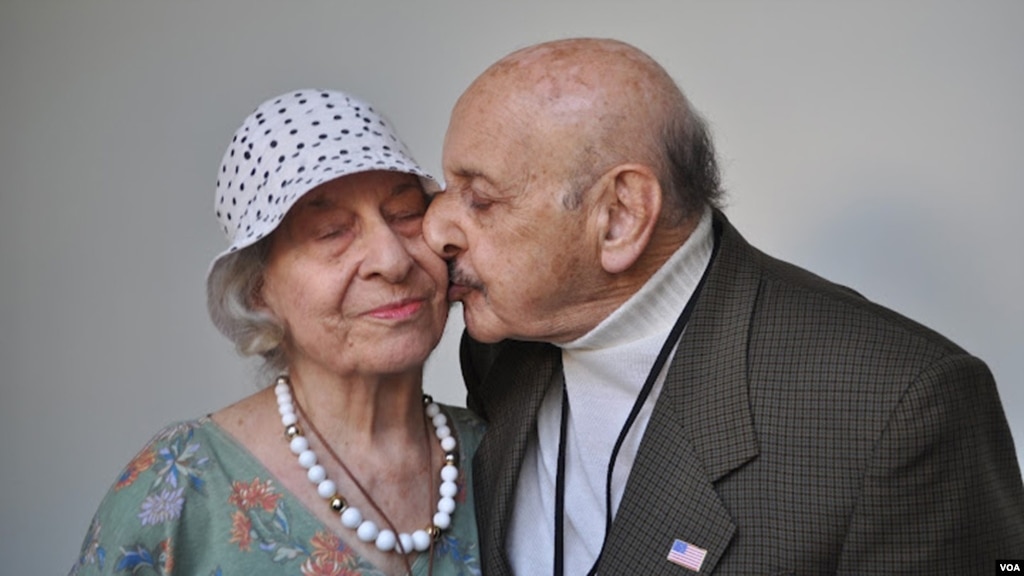
Ashley Thompson, VOA Public Relations and Anastasia Kolobrodova, BBG Public Affairs. Sent in by SaharMohammadi.
SPOTTED: Another set of fashion twins in the Cohen Building! This week countless DC residents are putting away wool shift dresses in favor of breezy sundresses. Ashley Thompson and Anastasia Kolobrodova embrace summer fashions as the weather recovers from its winter gloom.
Tune In is always looking for fun photos and stories! Have you seen more fashion twins around the building? Do you have a photo of yourself or a colleague on assignment in an interesting place? Send them toakolobrodova@bbg.gov!
Over the last several years, Tune In has been a great place to post profiles of individuals in the building, look back at U.S. international broadcasting history, showcase fun employee events, and generally form a sense of community around our workplace.
As we've covered these things, questions have come up on why these posts are limited to only our internal blog. Your accomplishments are awesome, our events are wonderful, and our history is fascinating.
To this end, we've launched Notebook, a public-facing blog, which will include interviews, photos, and other behind-the-scenes looks on the amazing things that our organization does every single day.
We hope that Notebook proves a useful place to connect with broadcasting on a personal level and we hope that you will share their own stories. If you would like to submit a photo for Notebook, participate in an interview for a behind-the-scenes feature, or if you have a fun story about our history to share, please leave a comment or contact Anastasia at akolobrodova@bbg.gov!
VOA's Jim Malone covers the 2012 Presidential inauguration
Jim Malone, a
National Correspondent for VOA who has covered his share of U.S.
presidential inaugurations, says the quadrennial swearing-in ceremonies
have global importance because they “put America’s best face forward and
affirm American democracy.”
Coverage of inaugurations, Malone says, can show the world how
democracy works. They are moments in which the “country pauses and
recognizes the vote that has occurred. No matter what, every four years
this country has seen a peaceful transition of power. That is a strong
symbol of democracy. It shows it can be done.”
Malone first covered the second inauguration of former President
Ronald Reagan in 1985 as an on-air anchor for VOA’s English to Africa
Service. Later, in 1993, he started to regularly report on inaugurations
from Washington, D.C. and has been an active reporter on the political
beat ever since.
One of Malone’s most memorable experiences came in 1997 at the second
inauguration of former President Bill Clinton. He recalls that it
displayed ‘grassroots America’ as hometown high school bands and people
from Clinton’s past were invited to the inaugural parade.
“A national mosaic filed past the White House” that day, he remembers.
While Malone sees inaugurations as a way to present American ideals,
he also recognizes that they can be challenging news stories. Malone
insists that it is VOA’s responsibility to tell the story of the United
States in a fair and balanced way, and this often includes
explanations of American history and institutions.
With this in mind, Malone also acknowledges that not all
inaugurations have the same historical weight. “I don’t think I can
remember a more exciting inaugural time than four years ago. The country
was experiencing changes that spoke to its history and to its racial
tensions.”
This year, he reports, the crowd was less emotional as the nation’s
expectations were tempered with the realization that politics is tough
and change comes slowly. This is the case with most second-term
inaugurations, but Malone believes that it was especially true this time
around because the US is emerging from a “rough period” and “sharp
divisions remain.”
However, Malone remains hopeful that the inauguration can provide
some benefit because it is less partisan than other political events,
and organizers try to be inclusive of all Americans. Inaugurations,
according to Malone, are “for everybody. They are a time to celebrate
and can be seen as a symbolic moment of healing.”
John Lennon's retirement celebration was last Friday.Below watch the amazing video that Amish put together, see photos from the party, and read John's farewell speech.If you have memories of John that you would like to share, please post them in the comments!
Text of John Lennon's farewell speech:
I came to work at VOA at time when things were simpler in some ways, and our job was more easily defined.In those days Congress funded VOA as an adjunct to USIA’s efforts to tell America’s story to the world, to help win hearts and minds, to combat Soviet disinformation in the raging Cold War.We sent radio programs on shortwave across distant borders to people we couldn’t see.We didn’t know who they were, and we didn’t know how many we reached.For the most part, those concerns were secondary.It would be a generation before we would talk about markets, and brands, and demographics.The competition in those days was for hearts and minds, and the only competitor was the monolith to the east.
In the late 1960s Lyndon Johnson was serving out the end of his presidency, having been driven from office by a war in Southeast Asia that was far from over.China had just begun its disastrous Cultural Revolution, and commentators figured it wouldn’t be a player on any world stage for at least a century, if then.Europe was sharply divided, military dictators ruled most of Latin America, and it would be another decade before the US would begin to recognize the potential of post-colonial Africa.Closer to home we were comforted by predictions that Fidel Castro would be overthrown in a Cuban uprising just any day.
Because we thought it was good for the world and good for us, America offered food aid, schools and hospitals, Peace Corps volunteers by the thousands, and scholarships for young people who wanted to come to the US to learn because they had no way to earn a degree in science or engineering or medicine or law at home.We offered that chance, and people took it… in those times and for years to come, we offered hope – and people needed it.
The world hadn’t yet heard of HIV-AIDS, or global warming, or OPEC, or crack cocaine.Among broadcasters, FM was a seldom-used diversion, TV was a black-and-white curiosity, “digital” was a word used in the study of anatomy, and “Internet” described a complex method used by fishermen for sweeping up bottom-feeders.Among journalists, newspapers and wire services were king. The foreign correspondent was a god, a remote but omniscient deity at the end of a fuzzy phone line whose word was never questioned, whose reports were eagerly sought, and who, in some cases, enjoyed being out of sight by staying drunk for years on end.Competition for such positions was all the more ferocious.
On the whole, journalists fiercely debated the importance of objectivity, the value of green-eye-shade editing, the imperatives of careful sourcing and deadlines and good writing.Universities offered new degree programs in journalism and communications.If public service was a public trust, the Fourth Estate declared itself an even higher calling, a watchdog, the last line of defense against corruption – the best example of high virtue in a Jeffersonian democracy, touted by people who hadn’t yet heard of Sally Hemmings.
In that tense time, as post-war journalism matured, and as Cold War diplomacy dominated the headlines, the Voice of America was moving into a new era.Its coverage of wars in the Middle East and Southeast Asia, of the turbulence of American social and political change – and, later, of the constitutional crisis called Watergate – all these efforts brought new respect for VOA reporters in the field, and for our broadcasts around the world.And with this respect, it came to us – a dawning awareness of new responsibilities for accuracy, for balance, for comprehensiveness in covering American life and US policies… values that would find their way into a VOA Charter that was already in draft, and would later be passed into law.
Then as now, “integrity” was a word much in use… and people who moved between journalism and government were viewed as having been compromised in their integrity, more interested in personal advantage and reputation than in the values of one calling or the other.Then, as now, a small chorus maintained that neither the career politician nor the ink-stained wretch were particularly honorable in their pursuits, and called for a pox on both houses.
As to whether VOA could maintain a reputation for integrity in those years, a famous and respected broadcast journalist – John Chancellor – summed up a view toward the end of his brief tenure as Director, a view that stuck with us for decades – that VOA was at a crossroads, at an intersection between journalism and diplomacy, with responsibility for deciding on any given day, or story, which way to go.Damned if we went this way, damned if we went that way.
It was a heady problem in those days, those days of a bipolar world dominated by Cold War tensions and daytime dreams of a nuclear nightmare… but today, the dilemma of 50 years ago seems quaint, as gripping as it was then.By contrast, today’s problems are technically more complex, politically more urgent, more personal, more compelling, more desperately in need of solutions.
If VOA was at a four-lane crossroads with one swinging stoplight in the 1960s, today it is in danger of getting lost in the speeding swirl of honking traffic on the world’s over-lapping information clover-leafs and multi-lane Autobahns.We don’t just face the consequences of making a wrong turn… we are faced with the certainty of becoming road kill, pancaked by behemoths, torn apart by “transformers” – unless we are both nimble and strong; intelligent and responsive; skilled and intuitive; quick-witted and thoughtful; well motivated and well led; proud – and also humble.With respect to Mr. Chancellor, today’s a hell of a time to be in our business.
There is a way out of our current dilemma.But all of us – all of you – have to take ownership.VOA need not be as rich as Chinese TV, or as ubiquitous as Russia Today, or as aggressive as Iranian media, or as pointed as Aljazeera.Instead we can agree – and I think we can all agree – that we have the methods and the motivation to become the most respected and sought-after source of news and information in the world.That’s a tall order – but why not?If that is VOA’s vision of itself, what is to keep us from setting the goals that will get us there?And what needs to be done to remove the barriers in our way?There are things that we can do – and I’d like to leave you with some thoughts about three of them.
First, VOA journalists in every language must focus on original reporting on all media and, in the context of that reporting, they must identify clearly with the concerns and the issues and the problems facing their audiences.Lingering Cold War methods must be discarded.People in search of news no longer have to wait for us to translate vetted English-language copy drawn from secondary sources… they have only passing interest in our version of events they heard about yesterday… and most telling of all, the growing billions of young people glued to their cell phones around the world want to know what’s of interest to them now; the rest they regard as mostly irrelevant.We have to know what interests and excites that audience, those young people, those consumers of our broadcasts, and take every bit of our mission to them on today’s platforms in original stories that are written and produced in a way that compels them to stick with VOA – because we care about them, and about their issues, and who they are.
The second is related to the first.Compelling original reporting that will draw audiences to VOA’s mission can only be truly successful if we learn as much as we can about today’s audiences, the people who consume today’s media, in today’s markets.Audience research and information may come from Gallup, or InterMedia, or personal travel or interviews, or a careful review of the Internet… but it is essential to the daily preparation of material by journalists focused on pulling in an audience.If you don’t know who they are, you can’t talk to them, or about them – or about anything that will interest them.This essential component is sometimes overlooked in favor of predispositions or conventional wisdom or old habits; VOA journalists in all languages must be professional enough to admit the possibility that they need greater knowledge and understanding when it comes to the people who matter most – the members of our audiences.In the same way, we need to know as much as we can about the markets in which we’re operating – whether we’re on TV and FM, or shortwave, or the Internet; how much of what kind of media do audiences use, to get what kind of information, under what conditions?These are important questions that need answers before you can prepare that compelling original story.Performance Review and OMPP have substantial resources to help in this regard, and all of you have resources of your own.They must all be put to use.
The last step that we need to take is one that can’t be taken by VOA alone.It’s a step that requires leadership, and wisdom, and a true embrace of a vision for all of US international broadcasting.The step is one that brings all of our competing entities into the same tent, a big tent that accommodates many brands, but that also requires collaborative efforts at building audiences around the world and especially in places where the need is greatest.Our original multi-media products must be tailored to meet the needs of specific audiences and markets, and adapted to inform audiences elsewhere.All brands and media platforms must be accommodated by unified systems for production and distribution.This streamlined agency must be led and managed by a Chief Executive Officer hired by an Advisory Board.For all of this we need strong and visionary leadership at the top of our Agency.VOA can’t take this step alone.
This last step must be taken because the world is not as simple as it was 40 and 50 years ago, not in any way.Today we must be competitive at many more levels and in many more ways than in the bad old days of the Cold War.A failure to adapt to updated requirements will leave VOA and all of USIB competing with itself, unable to get out of our own way, run over by the behemoths that roll around on the information clover-leafs of the 21st century.In that case the day will not be far off when VOA becomes, once again, an adjunct to a public diplomacy apparatus – delivering messages when we should be distributing information to audiences that need VOA now more than ever before.We need to take action.
After countless broadcasts, performances and 9:30 meetings, John Stevenson is retiring. From running VOA’s first FM network to his years guiding VOA’s English Division and music programming, John has played an important role in VOA’s success. This Tuesday, December 18, many across the organization gathered in the VOA Briefing Room to celebrate his career and achievements.
A wide range of speakers expressed their thanks for John's service to the agency, and emphasized the important role that he has had not only in music programming and VOA's English division, but also his role as a mentor to many individuals across the organization.
"It has been a privilege truly to work with all of you and to serve at VOA," John said, and gave credit to his staff. "You guys always rolled with punched. You never compromised. You always did your best. Don't ever give up on that."
When new employees join the BBG team, the onboarding process now includes a modest swearing-in ceremony with our executive leadership. Read more on bbg.gov and also see some of the new faces in the building in the photo below!
John Lennon swears in Pinitkarn Tulachom (TV Production
Specialist/Thai Service)
Dick Lobo swears in Jodie Thompson (Equal Employment
Opportunity Specialist/Office of Civil Rights) and Alex Greenlee (Human
Resources Specialist/Office of Human Resources)
John Lennon, Dick
Lobo, Pinitkarn Tulachom, Jodie Thompson and Alex Greenlee
Jason Lambro, veteran editor for the Voice of America, completed the ChesapeakeMan Ultra Triathlon on Saturday, September 29. The competition took place across 140.6 miles of Maryland's Eastern Shore, and included a 2.4-mile swim, a 112-mile bike ride, and a 26.2-mile marathon.
Below, Lambro answers some questions about the experience, and how he was able to prepare for the 140.6-mile endeavor.
Q: Why did you decide to participate in the ChesapeakeMan Ultra Triathlon?
A: Honestly, to see what I was made of. It was a “dare to be great challenge” I set for myself. I thought that if I could do this, then there isn’t anything out there I couldn’t achieve.
Q: How did you prepare for the competition?
A: I trained for over eight months preparing for this Ironman competition. It was a rigorous schedule. Monday, Wednesday and Fridays, I’d wake up a 4:30 AM for my morning swim practice (swimming anywhere between 2 to 3 miles) and then start a full day of work at VOA. Afterward, I’d go across the street to the HHS gym and work out for 1 ½ hours to 2 hours. Then I’d hit the mall for a 10 mile run starting along the Potomac into Georgetown, crossing the Key Bridge and coming back on the VA side, looping back on the 14th St. bridge. Then on Tuesday, Thursday and Saturday, I’d focus on long distance biking. That was more a gradual build up. You start off doing 30 miles and increase as you build up your stamina. By the end of my training I was biking 60 to 112 miles every other day. Sundays were rest days.
Also, nutrition played a huge part of my training. Vitamin supplements, protein shakes, electrolytes, salt tablets, amino acid drinks, more protein, lots of potassium like bananas, definitely fruits and always, always, always stay hydrated. You burn through so many calories because your metabolism is supercharged. You’re even burning calories while eating and sleeping. In fact, during an Ironman competition you have to consume close to 17,000 calories during the race just to maintain your stamina.
Q: What was the hardest part of it for you?
A: The mental aspect was definitely the hardest part. There were “off days” when I’d say to myself, ‘Why am I doing this again? This is crazy. What made me think I could do this?” Doubt and the unknown variables associated in training can literally stop you in your tracks. Just thinking about the distance you have to travel can psych out. It’s very easy to convince yourself that you’ve bitten off more than you can chew. Especially on days when the temperature outside is in the high 90’s for weeks on end. Or you wake up in the early morning hours and it’s raining outside but you still have to train. Keeping a positive outlook and having a strong mental game in facing everyday challenges is what always pushed me through the difficult times.
Q: What is your favorite part of working at VOA?
A: There are so many great people that work here at Voice Of America. I've been very fortunate to work alongside the hardworking men and women in the TV Studio Department, Language Versioning Service and several of the Language Departments. I've always enjoyed all the diverse cultures and backgrounds that come together and work side by side daily.
Many across the organization gathered today to celebrate the career of Dave Shiben, the now-retired head of the U.S. International Broadcasting Bureau’s Satellite Engineering & Transmission department. From 1987 to 2012, Shiben has seen the Broadcasting Board of Governors evolve from broadcasting primarily in shortwave to today's high-quality, high-tech satellite broadcasts. He was presented with the Gold Medal Award as well as the Career Achievement Award.
"I am happy to be here to celebrate your achievements and the great contribution you've made to the technological evolution of this agency," said Dick Lobo, citing specifically the work that Shiben as done with regard to combating Iranian satellite jamming.
"When he says that his motto is that 'failure is not an option' he not only says it he lives it," said Andre Mendes about Shiben's work ethic.
"Dave is one of the best people in this building, and it is a real loss having him gone,"said Barbara Brady. We all share that thought. Dave Shiban will surely be missed.
Kate Neeper and Karen Dupree. Sent in my Douglas Schuette.
SPOTTED: Another set of fashion twins in the Cohen Building! Kate Neeper and Karen Dupree embrace fall fashions with wool skirts and magenta sweaters.
Tune In is always looking for fun photos and stories! Have you seen more fashion twins around the building? Do you have a photo of yourself or a colleague on assignment in an interesting place? Send them to akolobrodova@bbg.gov!
When new employees join the BBG team, the onboarding process now includes a modest swearing-in ceremony with our executive leadership including International Broadcasting Bureau Director Richard Lobo and VOA Director David Ensor. Read more on bbg.gov and also see some of the new faces in the building in the photo below!
VOA Director David Ensor, Sisovann Pin (Khmer Service) and John Tolson
(Africa Division)
Douglas Schuette and Jeff Trimble. Photo sent in by Kate Neeper.
SPOTTED: Fashion twins in the Cohen Building! Douglas Schuette and Jeff Trimble are well-prepared for fall in their sweater vests -- a crucial clothing item for keeping warm during cold autumn winds.
Tune In is always looking for fun photos and stories! Have you seen more fashion twins around the building? Do you have a photo of yourself or a colleague on assignment in an interesting place? Send them to akolobrodova@bbg.gov!
Natalie Illum, Travel Specialist in the Office of the CFO, was the mistress of ceremonies for National Disability Employment Awareness Month program at the BBG earlier this week. Outside of the BBG, Illum performs as slam poet, an art that's helped her deal with the frustrations of living with cerebral palsy.
When new employees join the BBG team, the onboarding process now includes a modest swearing-in ceremony with our executive leadership including International Broadcasting Bureau Director Richard Lobo and VOA Director David Ensor.
Read more on bbg.gov and also see some of the new faces in the building in the photos below!
VOA Director David Ensor swearing in Mariama Crandall, Jeremy Groce and Scott
Storkel
IBB Director Richard swearing in Sharla Patterson, Renea Ramos and Brian
Williamson
"Three Bolts" -- Brian Allen's winning photograph.
Brian Allen,a journalist with the Voice of America and an amateur photographer, recently had his amazing photo of three lighting bolts over DC win NASA's GPM Extreme Weather Photo Competition. The photo was featured far and wide, even making it as far as the French newspaper, Le Monde! [Read more about how the photo was taken here.]
Leo Sarkisian, the creator of Music Time in Africa, VOA’s longest-running radio show, retired last week. You can read about his life and career, and see more photos at:
Tune In recently sat down with Bob Long, Program Analyst at the Office of Performance Review, to hear about his adventures fishing in Anchorage, Alaska. Long started working at OPR this February, but his first experience at the Cohen Building came at a much younger age. He was just out of high school when he first set foot in the building, and was dazzled by the escalators in the main corridor.
For the last six years, Long has been going on fishing retreats with some friends, including David Watts, Jim Vance, Eric Robinson and Brendan Pinkard. From encounters with bears to the amazing scenery, the trips sound amazing. See below for a slideshow of photos from his most recent trip!
Lynne Weil presents Susan Andross the Career Achievement Award
Susan Andross, Congressional Coordinator at the Broadcasting Board of Governors, retired from government service August 31. Among her many accomplishments at the BBG, Susan substantially strengthened ties with Congress and related entities and enabled growth at the Agency, which included guiding the legislative effort to secure funding for new broadcast activities for the Middle East, Iran, Afghanistan and Pakistan.
Susan had a long and distinguished career. Starting as a Staff Assistant at the Subcommittee on International Operations, before moving on to become a Staff Consultant at the Committee on Foreign Affairs for the House of Representatives. Susan then moved on the the U.S. Department of State, where she served as a Legislative Officer, responsible for managing the Department’s authorizing legislation and for presenting Department policies and legislative requests to the Congress, primarily in the areas of administration, consular affairs, diplomatic security, and personnel. Following that, Susan came to the BBG to work as the Congressional Coordinator in 1999.
Susan's immediate plans are to spend time with
family, starting with a birthday celebration for her husband this weekend, and
maybe a seaside holiday before summer is officially over.
The road to the White House gets a little steeper over the next several weeks as the political parties gather for their quadrennial conventions, and journalists from U.S. international broadcasting stations will be there to cover the proceedings for audiences in dozens of languages and across multiple platforms. See a behind-the-scenes photo album of BBG journalists in action at this link!
Following up on our previous posts about Pitch Fest, Tune In wanted to highlight the ideas of the winners, as well as share a slideshow of some photos of the Pitch Fest semi-finalists luncheon! Below are photos of the five winners with Raina Kumra, and IBB Director Dick Lobo, as well as their original "elevator pitches" for their submissions. Following that, you can view a slideshow of all of the semi-finalists!
Nancy Coviello, VOA Africa Health Network
Vidushi Sinha, VOA Central News Health Producer & Reporter
The Global Health News Update (GHNU) is a video piece to be done 5 days a week covering global health news including the latest in public health, science of diseases, infections, ground breaking research, and medical breakthroughs. The piece's concept is that it will have 2-3 quick reports (of no more than 2 minutes each) and close with a :30 sec to 1:00 of health tips.) Also, people can be directed at the end of each piece to visit specific VOA websites for more information (websites can utilize weekly or monthly themes to have additional content, articles, audio pieces - to go more in-depth.)
A lighthearted weekly video series that discusses hot topics from the internet in China with an enthusiastic host, graphical and video elements. This program will cover popular topics on the internet. This will change from week to week. Chinese netizens often enjoy satirizing current news events, making creative nicknames with double meanings and cartoons heavy with social commentary. This program would examine these creations and discuss the back story as well as introduce the viewers to other such creations.
With Egypt on the brink of elections, this is a perfect time to document the Making of a Democracy and no station is better equipped to do this than Alhurra. With a Cairo Bureau already in place, we have production teams ready to take the lead. Maged Abo Ouf, who works for Alhurra in the Cairo Bureau, is a highly skilled Director and Editor who is also extremely connected to what is happening in the community besides being highly intelligent. Our Cairo team, being Egyptian nationals have the knowledge of where to get the best footage/stories for this project. This project is perfectly suited for Alhurra’s mission, part of which states “ it is the mission of Alhurra to be the venue for voices and free expression in the Arab world”. My vision for this project is really to make a documentary series but since we are in Promotion we can also create interstitials to supplement the idea of the series. I believe this project is perfect for our online presence and can be easily transformed for radio as well.
The Voice of America app for mobile devices will help deliver our content to millions of users worldwide in an easily digestible, familiar, and interactive format. Users will be able to watch VoA programming, listen to live radio, read breaking news, and share reactions via Twitter and Facebook - all in their native language.